Why You Start Dancing Before Your Brain Says To
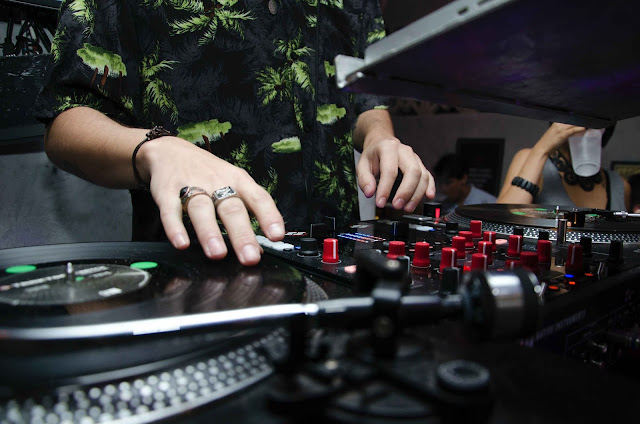
There's a moment every DJ knows. The room is full, the bass cuts out, a synth line climbs higher and higher — and five hundred people hold their breath at the same time. Then the drop lands, and every single body in the room moves at once. Nobody planned it. Nobody thought about it. It just happens.
Here's the strange part: it happens before anyone decides it should.
Your brain hears the future
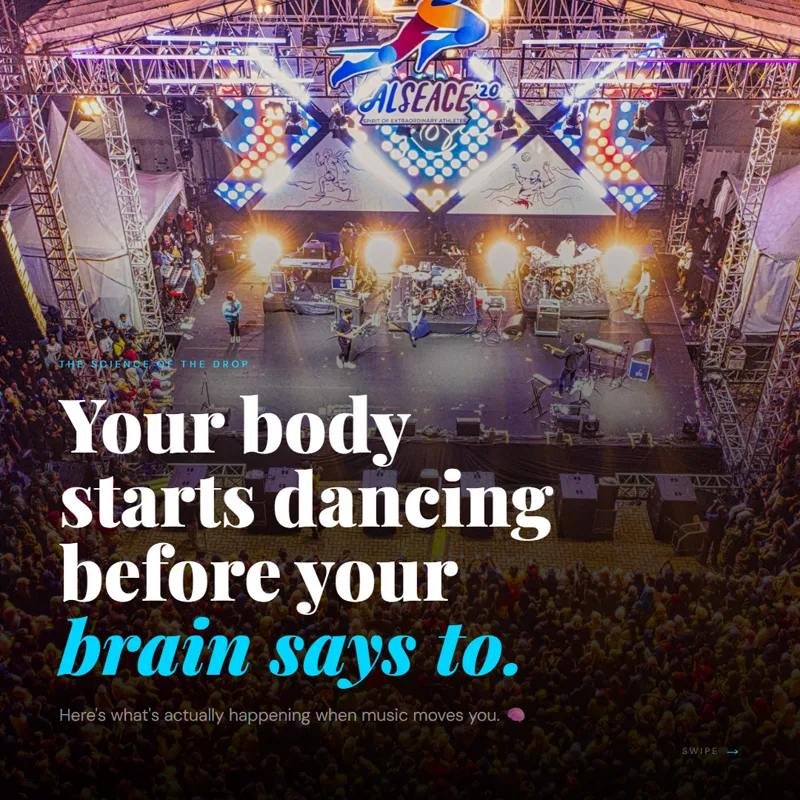
When neuroscientists put dancers and clubbers under EEG caps, they found something odd. The motor cortex — the part of your brain that controls movement — fires roughly 400 milliseconds before a predictable beat actually lands. Your body isn't reacting to the music. It's reacting to where the music is about to go.
This is because the human brain is, at its core, a prediction machine. It hates surprises and loves patterns, and a 4/4 kick drum is the most predictable pattern in popular music. Within a few bars, your brain has locked onto the grid and started placing bets on the next beat. When the bet pays off, you get a tiny hit of dopamine. Multiply that by 128 beats a minute and you begin to understand why a dancefloor feels the way it does.
Good DJs don't fight this machinery. They play it like an instrument.
The bass you feel in your chest is not a metaphor
Stand near a proper sound system and you'll feel the kick drum somewhere around your sternum. That's not your imagination — it's physics. Sub-bass frequencies between roughly 40 and 60 Hz are powerful enough to physically resonate in your chest cavity. Your ears barely register them, but your body does.
And here's the elegant coincidence: that frequency range overlaps with the rhythm range of a human heartbeat. Researchers studying rhythm perception have found that strong, low-frequency pulses don't just get heard — they get embodied. Your nervous system treats the kick drum less like sound and more like a second pulse in the room. You don't listen to sub-bass. You sync to it.
Thirty seconds to rewire a room
There's a name for what happens next: neural entrainment. When a steady rhythm plays, the electrical oscillations in your brain — your literal brainwaves — begin to align with the frequency of that rhythm. Studies measuring this found the lock-in happens fast, typically within about thirty seconds of steady exposure.
Think about what that means. A DJ who holds a groove for thirty seconds isn't just keeping people dancing. They are physically synchronising the neural rhythms of everyone in the room — to the music, and through the music, to each other. That feeling of being "locked in" with a crowd of strangers at 2am isn't mystical. It's measurable.
The loudest moment in a DJ set is the silence
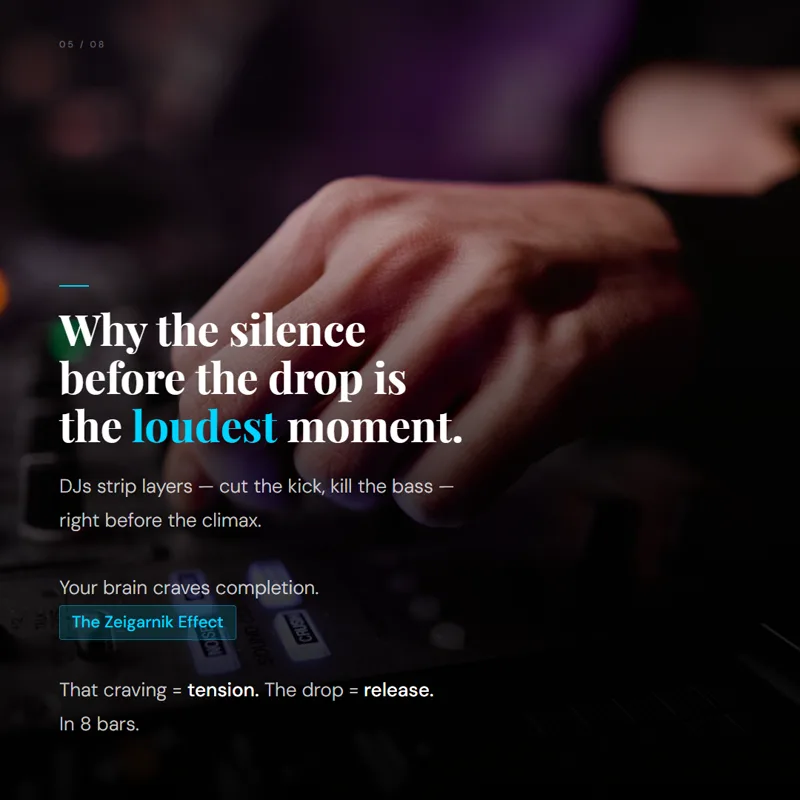
Every big-room track does the same thing right before its climax: it takes things away. The kick disappears. The bass drops out. Sometimes everything vanishes except a single rising note and the crowd's own voice.
This works because of a quirk psychologists call the Zeigarnik effect — the brain's tendency to fixate on unfinished things. An interrupted pattern is an itch the brain desperately wants scratched. The build-up creates a question; the silence makes the question unbearable; the drop answers it. Tension, then release. It's the same neurochemical arc as a cliffhanger at the end of a TV episode, except it resolves in eight bars instead of a week.
Producers engineer this into tracks. DJs engineer it into entire nights — building tension across songs, holding back the biggest tune just one track longer than the crowd expects.
Why 128 BPM?
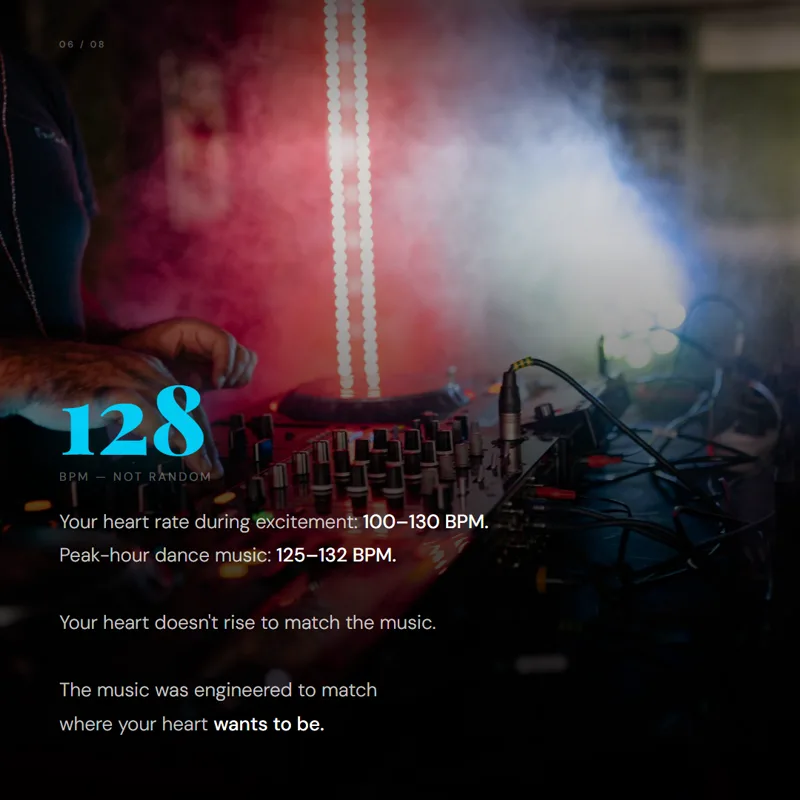
House and techno didn't settle around 120–130 BPM by accident. Your resting heart rate sits around 60–80 beats per minute. Under excitement — dancing, anticipation, a great night — it climbs to roughly 100–130 BPM. Peak-time dance music lives in exactly that window.
The music doesn't drag your heart rate up to meet it. It's built to match where your excited heart already wants to be. When the tempo of the room and the tempo of your body agree, dancing stops feeling like an activity and starts feeling like a state.
So what does a DJ actually do?
Put all of this together and the "DJs just press play" joke falls apart. A working DJ is reading a room and making constant decisions: when to build tension and when to release it, when to hold a groove long enough for entrainment to do its work, when the crowd's energy is rising and when it needs rescuing. Every transition is a choice about the emotional state of hundreds of people at once.
The equipment is the easy part — you can learn beatmatching in weeks. The craft is everything above: reading energy, structuring a night, knowing why a floor moves and not just that it moves. The dancefloor is a science experiment, and the DJ is the one running it.
We made a 60-second version of this article — watch it above, or catch the full carousel on @partymapacademy.
If reading this made you want to stand behind the decks instead of in front of them — that's what we do. PartyMap Academy has been training DJs since 2011, with alumni who've played everywhere from Mumbai clubs to Tomorrowland. Courses run in Mumbai, Kolkata, Bengaluru, Thane, Guwahati — and online from anywhere.

Comments
Post a Comment